Monday, November 16, 2009

Where To Buy Scholl Shoe

dark.


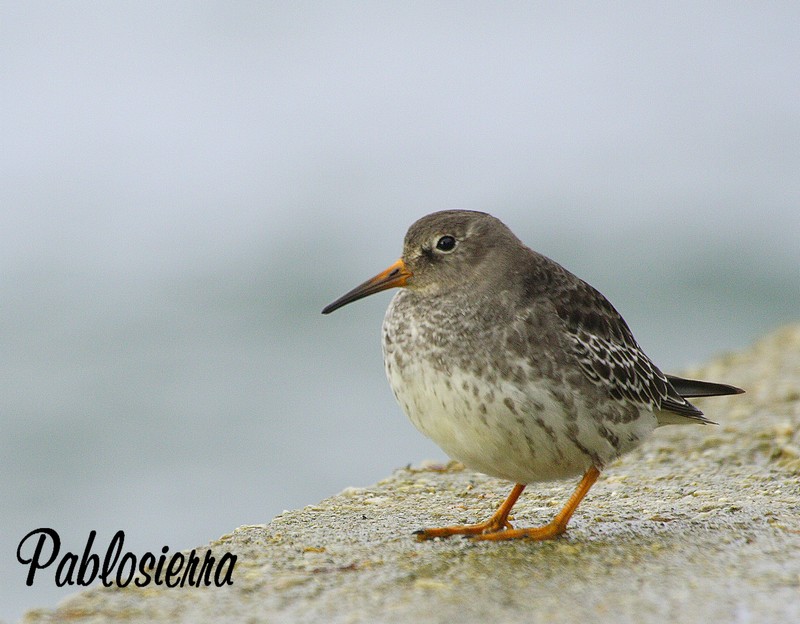
Sandpiper dark. (Calidris maritima) .
The dark sandpiper is one of the rarest and least known species of wintering shorebirds from our shores. Unlike its congeners, that frequent beaches, bays and estuaries, the sandpiper prefers dark coves, cliffs and crags, subject to the pounding waves, a circumstance that significantly hinders observation. Also frequent artificial constructions, such as jetties and breakwaters, Whenever they are exposed to waves.
This limicola, breeding around the Arctic, a place he left in July to meet in the northern islands, in August-September, they go to their usual winter in the North Sea, so its presence on our shores, is not the most common.
It feeds on invertebrates, but in breeding season, may include plant matter in their diet.
The nest is located on the ground and consists of a small cup covered with willow leaves.
The development of three or four eggs, takes place between mid May and mid July. Incubation lasts 21 to 22 days, after which the chicks are born, which like almost all waders are very precocious.
bird is a very confident, the last two photos are taken at 200 mm. (As at 1 - 1.5 mts.'s Target).

Monday, November 2, 2009

4 Weeks Pregnant Dry Mucus

Little Egret.

Little Egret. (Egretta Garcette).
The common egret, is a member of the family Ardeidae completely white plumage. Its long bill is black like their legs, except the fingers, which are yellow.
Individuals players, look in the head a couple of long feathers, and chest and back, some feathers elongated and filamentous elements that lack the non-breeding.
This species is resident in the region, but numerous individuals, running movements, both dispersive and migratory character of different entity. Thus, it is common for some birds moving north of our country after the breeding season, and others do so to the north of Africa for the winter.
The common egret, is a kind zoophages, like all herons. Their diet, are mainly small fish, amphibians and insects. Make an active hunting, nervously stirring the mud with their feet to chase their prey, on the contrary, such Grey Heron (Ardea cinerea) that waiting game.

Wednesday, October 28, 2009

Creamy Cm Right Before Period

juvenile ringed plover. Needle


ringed plover. (Charadrius hiaticula).
This specimen is a juvenile spotted on the beach in Navia, Asturias. I have to thank Eteban War, assisting with the identification, it was torn between this or a Semipalmated Chortlitejo. (Charadius semipalmeatus).
The images are not of great quality was testing with the duplicator. I've been very happy, as you can see quite clearly lost.
I leave a picture without the duplicate so you can see the magnification you get. (The distance would not be exactly the same, but did not differ too much)


Of the three species of plovers common in our country, the great, is the only one who does not play here because it is a bird's own high latitudes of the northern hemisphere, which only appears on our shores and wetlands in winter time in which you can see, both in the Mediterranean coasts and, especially, bathed in the Atlantic.
The reproductive cycle of this limicola, takes about 50 days, of which 25 correspond to the incubation of 3 to 4 eggs are the usual fantastic and the rest of the development of chickens.
The nest is usually located bare soil (raramante hidden among the vegetation) and is usually a simple depression in the sand just bounded by some plant materials.
During the breeding season, usually feed on small invertebrates, while elsewhere, including in diet polychaete worms, crustaceans and molluscs. Locate their prey by sight and after a short but fast race, with peak catches.

Friday, October 16, 2009

Wrestling Singlet Penn State

colipinta.

Last Saturday, I took another evening walk in search of birds and more specifically, waders. On this occasion, the venue was the Ria de Navia (Asturias) and more specifically, a kind of loophole closed by the part of the ria, a promenade and on the other sides by a forest of pine and eucalyptus.
I met with seagulls, laughing, three or four egrets and a pair of herons, but waders, the only thing I could see was this issue of what I identified as a needle colipinta. (Limosa lapponica) . Although I have doubts between it and the colinegros. (If anyone can confirm me, I'll be very thankful).
The day was not the most favorable for the photos, the clouds of a leaden gray, just let in some sunshine and timid as a target do not have enough light, the result leaves a bit to be desired. In this series of photos I've tried a new processing method, following the instructions in your field notebook gives Miguel Angel Madrid, adapting it better to have known what the programs I use. (Gimp and Photofiltre).
Thank you, Miguel Angel.


colipinta Needle. (Limosa lapponica).
The subspecies lapponica, which is what we see in Spain in time of passing immigration and more rarely in winter stay, breeding has its place in northern Europe and parts of Siberia, wintering (the few individuals who do in Spain ) mostly in the marshes of the Odiel and Guadalquivir, Ebro Delta and very rarely in the northern coast.
during the breeding season, has settled in the marshes or on the tundra near to these and rarely does inland Outside of this period, also shows a strong preference for coastal areas.
Its nest is a small depression in the ground cover plant material and located generally at some elevation between the marshes dry. The setting consists of two to four eggs in olive green color, the incubation lasts 20 to 21 days and chickens, at birth, are able to move and feed almost total autonomy.